Puzzle:
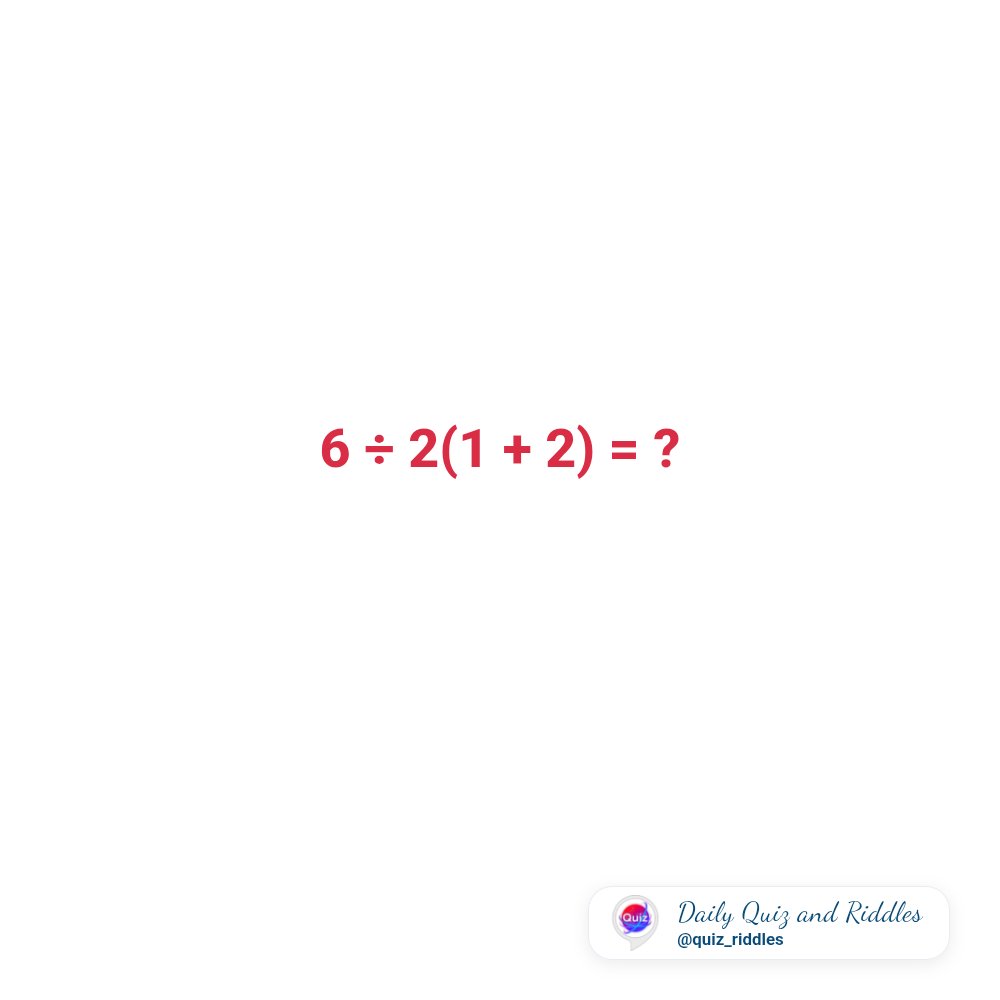
What is the correct answer to this classic order of operations problem?
6 ÷ 2(1 + 2) = ?
💡 Click to Reveal Answer & Step-by-Step Explanation
Answer:
9
Explanation:
Welcome, math enthusiasts, to a classic order of operations challenge that has puzzled many and sparked countless debates across the internet! This particular problem, `6 ÷ 2(1 + 2)`, is a perfect test of your understanding of PEMDAS (Parentheses, Exponents, Multiplication and Division, Addition and Subtraction) or BODMAS (Brackets, Orders, Division and Multiplication, Addition and Subtraction). The key to solving it correctly lies in remembering the crucial rule: multiplication and division (and addition and subtraction) are performed from left to right, *after* parentheses and exponents are resolved.
To crack this sequence, we need to carefully observe the pattern that governs its progression…
Let’s break it down step by step:
- Step 1: Parentheses/Brackets First
The first rule of PEMDAS/BODMAS is to solve operations inside parentheses (or brackets).
(1 + 2) = 3
Now, substitute this back into the original equation:
6 ÷ 2(3) - Step 2: Implied Multiplication
The expression2(3)means2 * 3. It’s important not to prioritize this multiplication just because it’s adjacent to the parenthesis. It’s simply a multiplication operation.
So, the equation becomes:
6 ÷ 2 * 3 - Step 3: Multiplication and Division from Left to Right
This is where many people get tripped up. According to PEMDAS/BODMAS, multiplication and division have equal precedence. You perform them from left to right as they appear in the equation.
First, perform the division:
6 ÷ 2 = 3
Now, substitute this result back:
3 * 3 - Step 4: Final Multiplication
Finally, perform the multiplication:
3 * 3 = 9
Now, what comes next in this intriguing sequence? Applying the pattern, we find: 9
There you have it! The seemingly simple problem 6 ÷ 2(1 + 2) correctly evaluates to 9. This riddle beautifully highlights the importance of following the order of operations strictly, especially the left-to-right rule for operations of the same precedence. Did you solve it correctly, or did this explanation clear up some common misconceptions? Share this tricky math puzzle with your friends and family and see if they can crack it without a calculator!
🔥 Can You Solve These Next?
- You are driving a bus. At the first stop, 10 people get on. At the second, 5 get off and 8 get on. At the third, 3 get off and 4 get on. What color are the bus driver’s eyes?
- A clock strikes 6 times in 5 seconds. How long will it take to strike 12 times?
- What comes next in this sequence? O, T, T, F, F, S, S, E, N, ?